Chaos sneaks up on you, right? One day your to-do list fits on a sticky note; the next you’re juggling emails, errands, and six apps with red notification dots screaming for attention. You don’t need a full life overhaul—you need a few habits that make the noise quieter and your day smoother.
Let’s cut the fluff and get you five habits that punch above their weight.
1) The 10-Minute Map: Plan Your Day, Then Actually Start

A plan doesn’t cage you; it frees you. Spend ten minutes in the morning mapping your top three priorities and the main blocks of your day. Keep this dead simple: a short list, not a manifesto. How to do it fast:
- Top 3: Pick three must-dos that move the needle.
Not ten. Three.
- Block your time: Assign rough windows (9–11 project work, 1–2 calls, 3–3:30 admin).
- Pad for life: Add 15-minute buffers between blocks. You’ll thank yourself later.
Mini rule: Start with a five-minute “win”
Kick off with a tiny task that builds momentum—a quick email, a calendar invite, a document outline.
Momentum beats motivation every time.
2) One Home for Tasks (Because Brain Tabs Crash)
Your brain’s not a filing cabinet; it’s more like a browser with 47 open tabs. Pick one place—paper or digital—and capture everything. Yes, everything.
If it lives in your task manager, it stops haunting you at 2 a.m. Good options IMO:
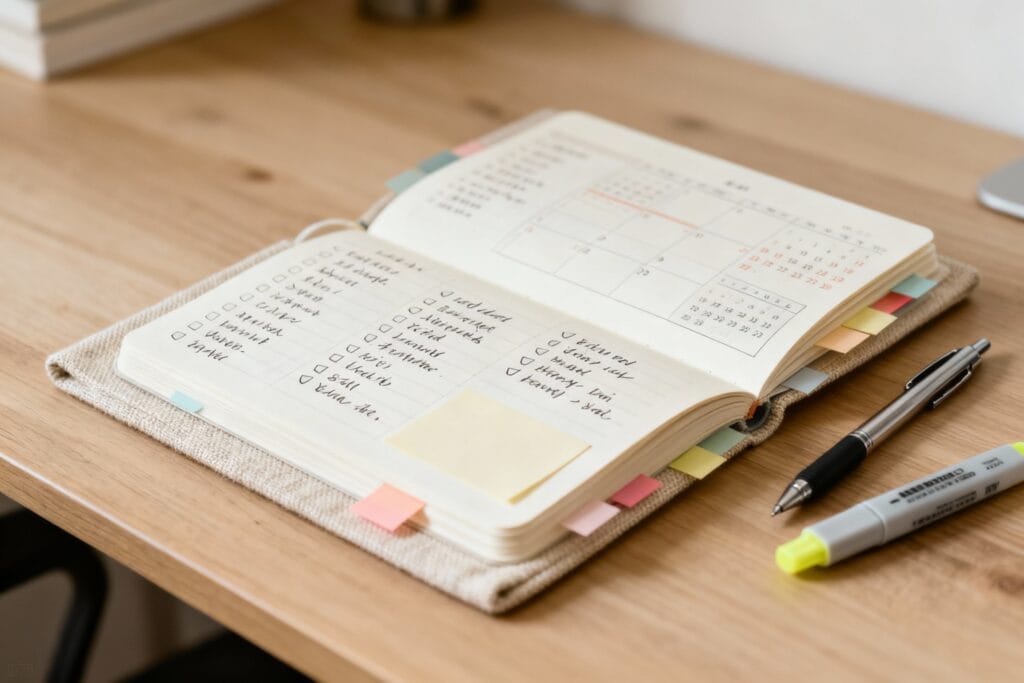
- Paper: A simple notebook or index cards (portable, distraction-free).
- Digital: Things 3, Todoist, TickTick, or Apple Reminders (searchable, recurring tasks).
Make it usable, not perfect:
- Quick add: Use voice or a widget. Friction kills habit consistency.
- Tags > Projects: “Errands,” “Deep Work,” “Follow-up.” Keep categories light.
- Daily prune: Remove the junk that sneaks in. You don’t owe every idea a future.
Weekly reset keeps it sane
Once a week, scan your list, update deadlines, and delete the nonsense.
Five minutes of cleanup saves five hours of chaos, FYI.

3) Time Blocking with Reality Checks
Time blocking shines when you add realism. Schedule your work in focused blocks and match the task to your energy level. Put heavy-lift tasks where you feel sharpest and save admin for your slower zones. Simple structure:
- Deep Work: 90 minutes with a clear target.
No tabs, no chat.
- Admin Sweep: 30–45 minutes for email, forms, bills.
- Meetings Cluster: Stick calls together to protect the rest of your day.
Reality check tips:
- Double your estimate: If you think it’ll take 30 minutes, it’s probably an hour.
- Guard one block: Treat one deep-work block like a meeting with your future self.
- Reshuffle without guilt: Plans change. Move the block; don’t delete it.
Breaks aren’t optional
No, you’re not a robot. Use 5–10 minute breaks to reset: walk, stretch, breathe, refill water.
Scrolling social media doesn’t count as a real break—nice try, though.
4) The “Two-Minute or Batch It” Rule
Micro tasks cause macro chaos. When something takes under two minutes—reply, file, schedule—just do it now. If it will take longer, batch similar tasks and do them in one sitting. Batching ideas that save your sanity:
- Emails: Two or three windows per day.
Inbox zero’s not the goal; control is.
- Messages: Reply in batches at set times to avoid ping-pong distractions.
- Errands: Consolidate and hit them once. Gas and time saved, mood boosted.
Hot tip: Turn off nonessential notifications. If everything is “urgent,” nothing is.

5) Close the Loop Daily
Your day ends well when you close loops.
Do a five-minute wrap-up to reset your desk, check tomorrow’s calendar, and pick your first task. This tiny ritual stops the “What did I forget?” spiral. End-of-day checklist:
- Clear your physical space—dishes, papers, cables.
- Scan your task list; defer or delete as needed.
- Set tomorrow’s top three and block your first deep-work session.
- Close all work apps. Yes, all of them.
Mind like water, not like spaghetti
When you trust your system, you stop spinning.
The goal isn’t perfection—it’s less friction and fewer open loops.
6) Standardize the Boring Stuff

Routine crushes chaos. You don’t need willpower when you have scripts for repeat tasks. Create reusable templates and checklists so you stop reinventing the wheel every Tuesday. Make once, use forever:
- Email templates: Outreach, follow-ups, meeting confirmations.
- Checklists: Trip packing, weekly review, content publishing.
- Meal rotations: A 10-meal roster for weeknights.
Decision fatigue? Deleted.
Bonus: Store templates where you actually work—notes app, email signatures, or a shortcuts bar. Obvious beats clever.
7) Design Your Environment to Nudge You
Your setup either helps you or sabotages you.
Build an environment that nudges you toward the work you want to do—and away from the stuff you don’t. Easy environment wins:
- One-tab workspaces: Use browser profiles or dedicated desktops for specific contexts.
- Visible tools: Keep your book, mat, or notebook within arm’s reach.
- Out of sight = out of mind: Put snacks and distracting gadgets in drawers.
- Focus modes: Set Do Not Disturb schedules that auto-activate during deep work.
IMO, friction is your secret weapon
Make bad habits harder: log out, uninstall, move apps to the last screen. Make good habits easier: pin docs, pre-open tabs, lay out gear.
FAQ
What if I fail to follow the plan by noon?
You didn’t fail; you learned. Do a midday reset: pick one thing you can finish, time-box it, and move the rest.
Plans serve you, not the other way around.
How do I pick my top three when everything feels urgent?
Ask: Which tasks move something meaningful forward? Which tasks have real consequences if ignored? Then choose one quick win, one important project, and one obligation.
That mix keeps momentum and responsibility balanced.
Is multitasking really that bad?
Yep. You don’t multitask; you context switch. Each switch costs time and focus.
Batch similar tasks and use focused blocks so your brain doesn’t need to reboot every five minutes.
What tools do I need to start?
Use whatever you’ll stick with. A notes app + a task manager + a calendar covers 95% of needs. Fancy tools help, but consistency wins.
FYI, the best tool is the one you open daily.
How long until these habits feel natural?
Give it two weeks to feel normal and four to feel automatic. Start with one or two habits, not all seven. Small, boring consistency beats big, dramatic sprints.
Wrap-Up: Less Chaos, More Calm
You don’t need to out-hustle the chaos—you just need to out-organize it.
Map your day, keep one trusted task list, block time realistically, batch the small stuff, and close loops. Layer in routines and environmental tweaks, and your days start to feel lighter. Keep it simple, keep it consistent, and let your habits do the heavy lifting.
EXPLORE MORE & SHINE DAILY
Discover self-care rituals, glow-enhancing routines, and beauty favorites in our BEAUTY section.
For cozy home inspiration, mindful routines, and soft everyday living, explore HOME & LIFESTYLE.
Find feminine outfits, effortless style ideas, and modern fashion inspiration in FASHION.
Love curated outfits and shoppable inspiration? Visit SHOP THE LOOK to recreate your favorite styles.
Looking for thoughtful ideas for every occasion? Browse our curated GIFT GUIDES.